
ON THE ATLANTIS PROBLEM
By Prof. Dr. Herman Wirth
[this article originally appeared in Der Schlüssel zum Weltgeschehen, issue 5 of 1929. The magazine in question was mainly focused on Hanns Hörbiger’s Welteislehre. Though Herman Wirth is not typically associated with Welteislehre, Hanns Fischer would praise him and Jörg Lanz in his book “In Moonless Times”]
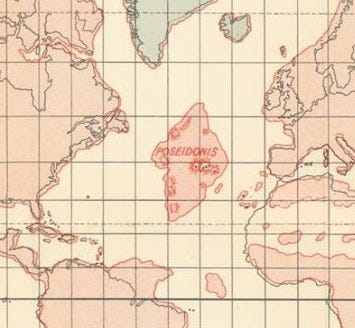
In recent times, this question has been taken up again from two sides: Adolf Schulten would like to identify ancient Tartessos with Plato’s Atlantis, while Leo Frobenius wanted to locate the same in West Africa. But both localization attempts are again purely speculative in nature and proceed only with major reinterpretations of Plato’s report, according to which Atlantis is explicitly described as a very large island in the ocean, west of the “Pillars of Heracles.” If the “Egyptian travel report” of Solon, which Plato utilized in his Timaeus and Critias, contains a historical core, then a critical examination of it must first delimit the still-preserved marginal area of Atlantis as the narrower field of investigation. This would be the coastal lands of Western and Southwestern Europe as well as the northwest of Africa.
From this surrounding area of a presumed great oceanic insular empire, Ireland is again the most important study area, because the greatest continuity can be assumed there—far greater than on the mainland of Southwestern Europe, where through the migrations of peoples in Europe and Africa, the bearers of that ancient tradition have for the most part disappeared or been absorbed into the foreign peoples overlying them. It is, however, possible that elsewhere we may still find some fragment of this tradition among the displaced and further-migrated former Atlantean tribal groups. For—if this great Atlantean insular empire existed and was consequently also a colonizing hearth from which settlement waves repeatedly reached the European mainland—we must also find recollections of this motherland in the oldest traditions of the peoples or tribes that arose from such a ver sacrum [sacred migration]. Every settler people takes at least the field names from its old homeland and transfers them to the new homeland. Likewise, it carries along the formerly common tribal name and retains it even in foreign lands.
If, then, relationships existed between the oldest continental-Western and -African cultures and a common Atlantean hearth, it is inevitable that in any comparative investigation of culture and linguistic history in this periphery, “Atlantis” will be unintentionally “discovered.” And that is exactly what happened to me during a comparative investigation of the cult symbolism of the Occident in connection with the origin of writing systems.
These writing systems show such great correspondences in regard to the signs, their phonetic values, and their cultic relations that any coincidence of independent local origin is excluded. Moreover, with the help of prehistoric monuments, the time and path of their migration can still be determined, and likewise the ethnological affiliation of their bearers can be established. A further extremely important clue emerged in this comparative investigation of script, language, and cultural history. These writing systems show, in their older layers, a correspondence that points to a former unified cultic foundation. In particular, their cessation (around 10,000–8,000 years B.C.) is only explicable if the relevant center of radiation ceased to exist at precisely that time. Since all the signs and their phonetic values are purely of a cultic nature, this center of radiation must have been a mighty cult center that, through its tremendous sea power, was able to maintain connection with the prescribed colonial settlements, just as these colonial settlements, for their part, did not lose contact with this center in cultic matters up to a certain point in time.
In particular, research into the oldest settlement legends of Ireland led to the trail of an entire cycle of legends that have as their subject the “sunken land,” the “sunken city,” the “land under the waves,” the “land of the ancestors,” the “fields of the blessed.” In Irish mythology, they occupy a large place and contain such rich elements of cult symbolism that from them the most important connections could be gained. While these legends are localized on the Atlantic coast of Ireland and northwest France, the cult-symbolic details could be further firmly anchored northward in the Germanic cultural sphere and southward especially in the Atlantic cultural sphere of West Africa.
The investigation of the mythologies of the Mediterranean and Mesopotamian cultures also yielded full agreement here for this “land in the west,” the “motherland,” the “sea land” as “island of the blessed,” “land of the ancestors.” Not only did a whole series of proofs emerge for the realm of the dead located in the ocean in the west, but certain details of that Irish and Breton legendary cycle were also confirmed by the statements of classical writers. In this way, it was finally possible to determine even the original name of that land which Plato calls “Atlantis.” The name of the land and of the peoples named after it could be traced not only in the Occident and on the west and north coast of Africa as far as the Near East, but likewise in North America!
A further subsequent ethnological, cult-symbolic, and cult-linguistic investigation of North American peoples (Indians and Eskimos) revealed their affiliation with that oldest epoch of the “Atlantean” culture that I have identified. The findings of settlement archaeology in Scotland and Ireland, as well as the Atlantean coastal lands of southwestern Europe and northwestern Africa, together with the anthropological evidence, inevitably led to the assumption of a migration of peoples that must have arrived in southwestern Europe and northwestern Africa from North America during the later epoch of the older Stone Age. The appearance of the Capsian and Magdalenian cultures is connected with their arrival. These “Atlanteans” advanced as skin-boat navigators from the north through the pack-ice region, which at that time still formed the connection between Ireland–Scotland on one side and North America (Newfoundland) on the other. They were the “sea-dwellers,” the “people of the west,” who inhabited the “land by the sea,” the “land in the west,” the “motherland”—a vast insular pack-ice territory that has sunk.
The most important anthropological and racial-historical result of the investigation, however, is that the origin of the Nordic race is now clarified for the first time in terms of developmental history. A preliminary comparative examination of cult symbolism and cultural-linguistic elements provides further proof that the proto- or pre-Nordic race must have arisen in what is now the “Arctic” region, in an area that encompassed present-day Grinnell Land, Spitsbergen, Greenland, and others. This “Arctic-Nordic” race partially migrated to northern Asia and the American-European pack-ice zone. The North American Indians are to be regarded as a variation of the Arctic-Nordic proto-race, while the Eskimos likewise represent a mixed variation, arising from contact between a proto-Mongoloid Asian group and the proto- or pre-Nordic race. In that American-European pack-ice region, the Atlantic-Nordic race then formed as an idiomatic variation. Its first waves, the South Atlanteans, were the inhabitants of the “land by the sea,” the “western land,” “Atlantis.” Their last wave were the “North Atlanteans,” the “Tuatha peoples,” who in the younger Stone Age conquered Scotland and Ireland from the north, proceeding from the then North Sea mainland, in battle with the south-Atlantic mixed peoples of southwestern Europe and North Africa. They were also the ones who settled northwestern Europe and Scandinavia (the proto-Germans). They are the bearers of the megalithic culture.
The Irish settlement legends have preserved for us here a wealth of the most important details, despite the later Celtic overlay and the obscuration through reworking by Christian chroniclers.
The intuitions of anthropologists who linked the Cro-Magnon race type of Chancelade with the Eskimo and recognized the Neolithic Irish skulls as the purest representatives of the Nordic race are confirmed in full scope by the new intellectual-historical research method. And the ethnological line of development established by the author coincides completely, on the other hand, with the results obtained so far by the young blood-serological racial research method.
Thus the legendary image of Atlantis rises in historically tangible form from the waves. And if one now reduces individual details of the already fantastically embellished tradition of Atlantis in Plato to their historical reality, we obtain a series of statements that are fully confirmed by prehistoric research.