
Ostara Nr. 26
A translation
OSTARA Nr. 26
Introduction to Racial Science
J. Lanz-Liebenfels
Printed as manuscript in the 3rd edition, Vienna 1930
Copyright by J. Lanz v. Liebenfels, Vienna 1909
Race and Racial Science
What is race? Geoffroy Saint-Hilaire defines race as “a succession of individuals descended from one another and distinguished by peculiarities that have become constant.” According to Quatrefages, race is “the totality of similar individuals belonging to the same species, which have received the peculiarities of a primitive variety and transmit them further.” Pouchet designates as race “the different natural groups of the human species.”
In contrast to these older definitions, Röse defines the concept of race more sharply and precisely as follows: “The concept of a human race comprises a sum of several physical characteristics. Individual ones of these can occasionally appear in another race. What is decisive is always only the overall picture.” (C. Rose, Contributions to European Racial Science, Berlin 1905/06, Archiv für Rassen- und Gesellschaftsbiologie, p. 132). It is particularly important, when assessing the individual races, not to rely on a single characteristic, but on the totality, the complex of characteristics.
This complex is namely not an arbitrary and accidental one, not something coming from outside, but a lawful complex of characteristics that is implanted in germ form in the individual races. As we shall show in what follows, there exists a strict correlation between the characteristics of one and the same race. Every race is based on certain formative (morphological) principles that are effective even in the construction of the smallest parts. In this sense, the existence of different human races is undeniable, because the differences in the overall picture of the individual human groups must strike even the layman.
I would therefore like race to be defined and understood as follows: Race is the complex of certain physical and mental inheritable characteristics that correspond to the different stages of development of humanity. In order to prevent any errors and misunderstandings, I would like to point out that in my writings I understand by race only what is designated as race in the above definition. If one deviates from the explanation of the concept of race given above, one exposes oneself to misinterpretations that can go so far that one (e.g. Finot [correctly: Finkelstein, a Jewish “Frenchman”], The Racial Prejudice, Berlin 1906) can deny the existence of human races altogether and dispute the legitimacy of racial science as a science.
Race, for example, is not identical with language, an error that has contributed much to the confusion of the race question. Thus, for example, today’s Spaniards, South Italians, Greeks and French belong to the Aryan language family, but by no means to one and the same race. Nor do all Germans belong to one race. It is actually astonishing that even in scholarly circles one could fall into such a childish error and seriously speak of a German, Czech or Italian “race.” It is quite obvious that, for example, a racial Negro can come to Germany as a child and learn the German language perfectly here. But that does not make him a man of the Nordic race by a long way.
Race also has nothing to do with folk or state affiliation (nationality). Neither all Germans (considered as a people) nor all Reich Germans (as citizens) are of the same race. Conversely, Germans, Slavs and Romans can be of the same race if the complex of their mental and physical characteristics is the same; likewise, members of different states, such as Swiss, French, Germans and Russians, can be of the same race.
If race is understood in our sense, then the reproach made against racial researchers and racial science—namely that they incite peoples against one another—is entirely unjustified. On the contrary, our conception of the concept of race forms the basis of a new idea of peace and a new supernationality, namely the phylological (racial) and ariosophical idea of peace, which aims at nothing other than to bring the racially equal and at the same time highest-raced individuals of all languages, peoples and states closer to one another for the welfare and salvation of humanity, and to unite them into a firm phalanx. This phalanx not only puts a stop to the suicidal struggle of members of the same race, but is also called upon to peacefully demarcate the spheres of power of the individual races and to assign to each race the place that it deserves by virtue of its natural disposition.
Even more disastrous for racial science was the confusion of the concept of race with the concept of religious confession. It is not permissible to speak casually of a Jewish and a Christian race or a Protestant and a Catholic race. Through this confusion, racial science has been drawn, to its greatest detriment, into the wretched confessional quarrels.
One more point should be mentioned in passing. Even the family name decides (at least nowadays) nothing about the racial affiliation of its bearer. For example, someone can very well bear a good German name, indeed even (legally) be a descendant of a Germanic noble lineage, and yet not be a man of the Nordic race. This phenomenon is not explained solely by racial mixing; for if someone has always had Germans among his paternal ancestors, then the occasional admixture of non-German maternal blood cannot completely erase the Germanic racial character. In these cases, there is rather marital infidelity on the female side and a falsification of the paternal line of ancestors. For this reason, marital infidelity on the female side also has incalculable legal and social consequences. Female infidelity must, however, unfortunately be taken into account (cf. Lanz-Liebenfels, Race and Woman and Her Preference for the Man of Inferior Type [“Ostara,” No. 21, published by Walthari Wölfl, Vienna, XIII., Dommanergasse 9]), something which racial research has so far neglected because of misplaced gallantry towards women.
On the other hand, female infidelity also brings it about that many people with names that do not even belong to European languages can be members of the Nordic race.
There are, however, also cases in which the family name can be regarded as a racial indicator and female infidelity can be ruled out. Female infidelity occurs less frequently:
In middle-class circles;
It occurred less frequently in petty-bourgeois circles and in the lower nobility (of Germanic countries) before the French Revolution and before the emancipation of women;
Female infidelity was rarer in those circles until 1500 A.D., as long as the orderly and racially highly beneficial medieval brothel system existed, which made a strict and just distinction between pleasure women and honorable breeding mothers;
The more Germanic a region is, the longer the Germanic sexual morality was effective and the more faithful the women were;
Family descent from a rural milieu offers greater guarantee of an unadulterated family tree than descent from an urban milieu. In garrison towns, university towns and Jewish quarters, one must always reckon with female infidelity and falsification of the family tree.
From the above it follows that genealogy is an important auxiliary science for racial science. When it comes to determining the racial affiliation of an individual, genealogy is a very important source—not in the sense that it decisively determines racial affiliation, but certainly in the sense that it exactly explains the origin of certain physical and mental characteristics. In this case, a fine German name can still be added as a special distinction and become a document for an outstanding racial nobility, which stands far above the ink or merit nobility conferred by a letter of ennoblement.
Hand in hand with genealogical research, the examination of family portraits also goes when investigating the racial affiliation of an individual. In some cases (which will probably rarely be possible for private individuals), the skeletons of deceased ancestors may also be examined. In this direction, the “Taphographia” of Marquard Herrgott constitutes a rich, as yet completely unexploited treasure trove for the European princely houses.
The study of pictorial representations (sculptures, paintings, medals, suits of armor — hitherto not yet utilized; the so-called Ambraser Collection in Vienna contains a considerable amount of material. The suits of armor in particular provide important somatological information: body height, proportions of the trunk and the extremities) is the concern of anthropological iconology. Anthropological genealogy must rely on this if it wishes to arrive at irreproachable results.
As further auxiliary sciences, racial science makes use of morphology, anatomy, biology, physiology, pathology, anthropology, ethnology, paleo-ethnology, prehistory, geology, and world history. Psychology, statistics, and criminal anthropology must also furnish not insignificant aids. Jean Finot therefore rightly remarks: “Under these circumstances, racial science assumes the form of an enormous field encompassing the entire biological and intellectual development of man.” This is understandable, for man is the microcosm, the world in miniature.
Depending on whether racial science deals with a field of knowledge that approaches the various auxiliary sciences more or less closely, it is divided into: general racial science and special racial science. Depending on whether it concerns itself merely with the investigation of phenomena and laws or with their application to practical life, it is divided into theoretical and practical racial science (racial economy).
Special branches of special racial science are: racial psychology (the study of the soul of the individual races), racial history (the history of the individual races and their influence on world history), racial aesthetics (the relation of races to the arts), racial philology (the relation of races to languages), racial sociology (the relation of races to social classes), racial pathology (diseases of the individual races), etc.
In conclusion, a brief reference should be made to a particularly frequent but misleading use of the term “racial hygiene.” In liberal scholarly circles in particular, all efforts to improve the physical health of the people are labeled “racial hygiene.” It is possible, through special measures, to breed healthy and strong people who are nevertheless mentally inferior and ugly. The fight against diseases and epidemics, against uncleanliness and neglect is in itself praiseworthy, but it benefits the lower races just as much as the higher ones. Strictly speaking, this hygiene, which is almost exclusively cultivated by the states today, ought to be called “people’s hygiene,” “state hygiene,” or “health hygiene.” “Racial hygiene,” on the other hand, must concern itself with the preservation and cultivation of the noblest and most beautiful race, that is, the blond, heroic race. The modern states neither want nor are able to do this; therefore they wrongly call the pampering of mixed breeds and inferiors “racial hygiene.”
In conclusion, only a cursory reference shall be made here to the errors of 19th-century racial research, because they have caused incalculable damage (perhaps deliberately!) to the development of this young and so fundamental science. These errors are based on the false method of determining racial affiliation on the basis of a single racial characteristic. This error was committed especially by the school of the leather-skinned and presumptuous Virchow, who thought he knew better than everyone else; for it classified the races solely according to the shape of the skull. Woltmann, on the other hand, neglected the shape and attached too great importance to the color of hair and eyes, while Chamberlain again conceived the concept of race in a one-sided philological and ethnological manner, as Gobineau had also done. These researchers therefore arrived at quite distorted and questionable results, which were thoroughly exploited by the opponents of racial doctrine — the liberals, Freemasons, and Jews — in order to bring racial science into disrepute as “unscientific.”
The Biochemical Differentiation of Races
I said above that the difference in the overall appearance of individual human groups is so striking that every unprejudiced observer must immediately recognize and distinguish the different human races. However, since racial science is exposed to so many attacks and to both conscious and unconscious errors, I do not wish to content myself with making a classification of races solely on the basis of the optical impression of the individual racial types. It is well known that the eye can deceive, and the opponents of racial science actually claim that racial researchers allow themselves to be misled by appearances. In order, therefore, to place racial science, and above all racial differentiation (race diagnosis), on a firm, natural foundation independent of the subjective (and sometimes not unprejudiced) judgment of human beings, I will first discuss two methods of racial differentiation in which nature itself carries out the separation and classification of human beings in an experimentally mechanical way. These are the biochemical and the physiological-electrical race diagnosis.
Only when we have provided irrefutable proof of the existence of different human races through the results of these diagnoses shall we turn to the discussion of the hitherto customary racial-scientific research method, the morphological-metrical race diagnosis.
Nuttall, Friedenthal, and Uhlenhuth, without in the least thinking of race diagnosis, established that the serum of a rabbit pretreated with human blood also produces a precipitate in monkey blood, but in no other kind of blood. Thus the blood relationship between man and ape was proved by a chemical-biological method (through the so-called precipitin reaction). From the degree of the reaction, however, it could be inferred that orangutan, chimpanzee, and gorilla reacted more strongly to human blood than the other apes. The possibility was thus found not only of determining relationships in general, but also of exactly fixing the degree of this blood relationship.
I had already proposed in my book “Theozoology” (the idea of using the precipitin reaction for race diagnosis originates with me and was first indicated by me in my fundamental work “Theozoology” in 1904. Cf. “Ostara” Nos. 5–9, 15–19. Since 1904 my discovery has developed into a new science with an extensive literature) to apply this method also to race diagnosis, in such a way that one measures the distances of the individual races from a common base.
By refining the blood reaction procedure through the so-called “complement fixation method,” Dr. Karl Brud has now succeeded in practically testing my theory. He treated 4 Dutchmen, 1 Arab, 4 Chinese, 4 Malays, and 1 orangutan in this manner. These investigations revealed four different gradations of blood relationship to the orangutan. Farthest removed is the Dutchman; one step lower stands the Arab (Mediterranean race); two steps lower follows the Chinese (Mongol); and still two steps lower the Malay (primitive mixed type), who is still five steps removed from the orangutan. (Tables and exact description of the experiments in the “Berliner Klinische Wochenschrift,” 1907, No. 26: “The Biological Differentiation of Ape Species and Human Races by Specific Blood Reactions.”)
This experiment has thus actually brought to light a substantial difference between the individual human races — one that extends right down to the composition of the blood — in a purely mechanical and completely objective manner. This experiment clearly shows that there are different races which possess blood respectively of the race of the Dutchman, the Arab, the Chinese, and the Malay. Unfortunately Brud was unable to treat a Negro. In any case, he would certainly have reacted in a particularly distinct way.
But Brud’s experiment has not only established the racial differences exactly; it has also determined the relative value of the different races — a question about which such violent disputes are raging today — in a completely objective manner, by clearly proving that the Dutchman and the Arab stand farther from the ape than the Chinese and the Malay. Where the Negroes are to be placed — either before the Chinese or after them — must be clarified by further experiments.
In any case, with the help of chemical race diagnosis we have established the following races, which follow one another in the following order of value:
A race with the blood reaction of the Dutchman.
A race with the blood reaction of the Arab.
A race with the blood reaction of the Chinese.
A race with the blood reaction of the Malay.
As a fifth race, whose place in the sequence has not yet been fixed by chemical race diagnosis, the Negro race would be added.
Yet my discovery of biochemical race diagnosis has produced even more far-reaching consequences in the field of blood group research, a science of the most recent times. In connection with blood transfusions carried out for healing purposes — that is, the transfer of blood from the veins of one individual into the veins of another — it was discovered that transfusions are only successful when the two individuals belong to the same blood group. It further emerged that these “blood groups” are identical with the four main races established by me.
Much in this new science is still unclear, but in general four groups have been identified:
Blood group A: a human race whose blood serum agglutinates the blood cells of a large group.
Blood group B: a human race whose blood agglutinates only blood group A.
Blood group C: a human race whose blood agglutinates no other blood group.
Blood group D: a human race that agglutinates only blood groups A and B.
Blood group A is identical with the blond, Ario-heroic race, and its original homeland is the northwest of Europe and the Atlantic coastal regions.
Blood group B corresponds to the Mongols, whose original homeland is Asia.
Blood groups C and D correspond to the Negroes and primitives; their region of origin is the tropics and similar areas.
The main publications on this highly interesting field come from Dr. Hirschfeld, P. Steffan (Results of Racial Research by Serological Methods, M. A. G., Vienna, LVI, 1926), Wellisch (Ethnological-Anthropological Observations on Blood Groups, M. A. G., Vienna, LVII, 1928), Leveringhaus (The Significance of Human Isohemagglutination for Racial Biology, Archiv für Rassenbiologie, Munich, Vol. 19, 1929), Schiff (The Technique of Blood Group Research, 1926). In Hungary, Prof. Ludwig v. Mehely has rendered great service in the field of blood group research. Riche in Vienna introduced blood group research into court practice for the determination of paternity, which caused a veritable panic among sexually active adulterous women. For now we possess a means of mechanically establishing every case of adultery and every falsification of family lineage in the test tube. One can understand that this method is being fought with the utmost fury by women and womanish men. In vain! The test tube will put an end to the gigolo system with automatic precision, and everyone will henceforth “pay cash for what he has consumed.”
The Physiological-Electrical Differentiation of Races
According to J. Gaube (Course in Biological Mineralogy, 4 vols.), the body of a human being weighing 68 kilograms consists of 44.66 kilograms of water, 21.30 kilograms of organic substances, and 2.04 kilograms of mineral substances. Among the mineral substances, lime, soda, iron, sulfur, and phosphorus play an especially important role. For example, every human being requires a daily intake of 1 gram of sodium per kilogram of body weight. The minerals serve primarily for the construction of the solid components of the organs and are excreted daily through the kidneys and especially through the skin. Thus, hair contains sulfur, lime, potash, silicic acid, magnesia, iron, soda, silver, arsenic, and even copper.
It is clear, therefore, that the chemical composition cannot be entirely the same in the different races, since the blood, as the chemical race test has shown, is also different. The difference in chemical composition, especially the content of metals and the manner in which the metallic components are deposited, can manifest itself not only chemically but also electrically in the form of greater or lesser conductivity. The different races do indeed react differently to electricity. The physiological-electrical race diagnosis is based on this fact.
We shall see that in the colored races the metals and other good conductors are deposited more in the skin and in the pigments. When an electric current is therefore passed through the body of a person of the pigmented, i.e., dark, type, the current takes the path of least resistance — namely through the pigment layer of the dark skin, which is more richly permeated with metallic elements and well-conducting acid secretions. People of the colored races are therefore less sensitive to the physiological effects of the electric current than races with light, pigment-free skin. In the pigment-free races, the metals are used more internally, especially for the construction of the nervous organs. For this reason the current also passes more through the interior of the body, particularly through the nerves, and thus exerts a stronger physiological effect.
The idea of diagnosing the races according to their reaction to the physiological effects of the electric current originates, like the idea of chemical race diagnosis, from me. Confirmatory experiments were carried out by Dr. Viktor Pimmer and Dr. Damm. These experiments are all the more important and convincing because both researchers intended something quite different from a race diagnosis.
Pimmer wanted to investigate the physical inferiority or superiority of Viennese schoolchildren with the help of the high-tension spark of an influence machine (Quarterly Journal for Physical Education, Vienna, German edition, 3rd year, p. 14). He writes the following about this highly interesting experiment: “It must be stated in advance that truly constitutionally ill children did not fall within the scope of these investigations at all. It is therefore only a selection of the capable from a mass that is usually described as healthy.”
Pimmer now found that one group of boys underwent the physiological effect of the electric current without much discomfort, while others were very sensitive even to weak currents. According to Pimmer, the external characteristics of the sensitive boys were: delicate body, pallor (i.e., lack of pigment!), bad teeth (compare below in the special section the frequent occurrence of dental caries in the heroic race, whose teeth stand closely together because of the smaller jaw), slight luster of the eyes, silky-soft hair. Mental characteristics: great eagerness to learn, mental precocity, exaggerated striving for success, in part a scattered nature with rapidly changing principles that are quickly discarded. Curiously, there were also some boys among them who did not fit my scheme at all: stubborn, sleepy, lazy (peculiarities of the maturing human being of the heroic race). ...
The characteristics of the (other) 10 boys were as follows: stocky body, barrel-shaped chest, red cheeks that easily turned deep brown in the sun, flashing eyes, bristly hair.
Pimmer had evidently omitted to separate the two groups according to racial characteristics in his scheme; hence the surprise. The second group, which tolerated the current well, is obviously the dark complexion, while the first, sensitive group represents the representatives of the light complexion.
Damm, on the other hand, found that when the electric current is passed through the human body, through the nervous system (spinal cord, brain) of healthy people, the same current loss always occurs, whether the person is strong or weak. There exists a constant magnitude that varies only in four directions: differently for the healthy adult male and the healthy adult female, and differently for the male and the female child. Sick people, on the other hand, show considerable deviations depending on the degree of scarring of the nerve fibers.
This experiment has, however, only indirect value for race diagnosis, in that it teaches that the current acts differently on those with healthy nerves, those insensitive to nerves, and those with diseased or sensitive nerves. Now, the light complexion corresponds more to the nerve-sensitive type. (I can observe in myself that thunderstorms announce themselves twelve hours in advance — even in clear skies — by headache, although I otherwise do not suffer from headaches at all. I notice rays emanating from bare metal — without seeing them — by the sweetening of the saliva. Evidently the saliva is chemically altered by the rays acting like an electro-intense current. “Clairvoyance” is a phenomenon peculiar to the blond complexion, as is “telepathy.” More on this in my racial psychology.) It is indeed an established fact that the light complexion is more nervous, which stands in correlation with the main pigmentation. On the other hand, these facts throw a new light on the hitherto obscure interrelationship between skin diseases (syphilis) and nervous diseases.
Here the characteristic pendulum and divining-rod reactions over photographs of high- and low-race people must also be mentioned, although they already border on the metaphysical. Over the pictures of high-race people the pendulum and rod reactions are circular, large, harmonious, and regular; over low-race people they are elliptical, confused, and irregular. (Cf. F. Kallenberg, Revelations of the Sidereal Pendulum, Diessen, 1913; Benedikt, Divining-Rod and Pendulum Theory, Vienna, 1917. Both unconsciously build on Reichenbach’s Od-theory.)
The Morphological Differentiation of Races
The test tube and the electric current, two unprejudiced witnesses, have clearly and definitively proved to us the existence of different human races. We can therefore trust our eyes when they perceive different body shapes and body measurements (proportions) in the different races. Our eye not only does not deceive us, but also confirms that the sequence and relative value of the races, as established by the chemical race test, also apply to the morphological and metrical method. This means: what the chemical race test has established as higher-value is also higher-value according to the morphological-metrical method of investigation, and the racial types that we shall establish by the morphological-metrical method correspond to the racial types that we have found through the chemical race test.
The entire cosmos takes shape, measure, and permanence through two forces: through the integrating, i.e., uniting, summing forces, and through the differentiating, i.e., driving and separating forces. Differentiation and integration are motion and rest; differentiation brings about change, integration brings about consolidation. The integral is always the older, for in the mixture of forms it contains the germs of the later, fully developed forms that can evolve in a certain direction through differentiation. The differentiated is the younger, the fully developed and advanced.
It is now a question of recognizing what in the human form is to be regarded as an integral and what as a differentiating formal element. We have three standards for answering these questions. This circumstance is particularly noteworthy, since one method of assessment controls the other; therefore, with careful examination, an erroneous conception is virtually excluded.
The first method, the phylogenetic (stemmological) method, compares the formal elements of man with the formal elements of the anthropoids, apes, and the fossil remains of pre-humans, and states: all those forms that approach the pithecoid (ape-like) forms are to be regarded as lower characteristics. The farther the formal elements have moved away from the pithecoid form through differentiation, the higher these characteristics are to be valued.
The second method, the ontogenetic method, draws its arguments from the developmental history of the individual human being and examines how the human forms gradually develop out of the embryonic and infantile (childlike) forms. Just as there are human races whose development does not rise very far above pithecoid shaping, so there are also human types that, after the completion of their development, constantly retain certain reminiscences of embryonic and infantile forms.
A second principle for morphological race diagnosis therefore emerges; it reads: the closer the forms are to the embryonic or infantile forms, the lower they are to be valued from the developmental-historical point of view. The more the forms depart from the forms of the embryo and child, the higher they are regarded.
The third method, the geometrical method, focuses on the course of the boundary lines and judges how far the forms depart from the integral line guidance. Mathematics, the most objective of all sciences, now teaches us that the circle and the sphere are the most integral structures. They are at the same time the most economical structures, i.e., they achieve the greatest effect with the smallest possible expenditure. The circle encloses the greatest area with a relatively smallest circumference; the sphere encloses the greatest volume with a relatively smallest surface. Circle and sphere are basic types for the great heavenly bodies, just as they are the basic types for microscopic organisms.
Corresponding to their integral character, the circle and the sphere are unoriented, i.e., they are structures that do not yet exhibit any definite axial direction; any one of the infinitely many diameters can become an axis. In this radial disposition lies also the passive and plastic character of the circle and sphere form. This means that the circle and sphere are those constructional forms that are best suited for differentiation in all possible directions.
We therefore obtain the third important proposition of morphology: forms that more closely approach the circle and sphere form are to be designated as lower forms, while the axial and more elongated forms are to be regarded as the higher ones.
It now remains to be asked how these three methods relate to one another. It is immediately obvious — and has already been partly indicated in the preceding — that what phylogenetics designates as a low characteristic is at the same time to be designated as low according to the ontogenetic and geometrical methods as well. For the phylogenetically, embryologically, and geometrically low forms are all more integral forms. It therefore never happens that a form which is to be designated as low phylogenetically is described as high-value by the embryological or geometrical method. We thus have before us a law which I would like to call morphological correlation.
There is, however, yet another very important morphological principle to be noted, to which we shall return in the special part of this racial science: namely, the law of morphological coupling. This law states that a low characteristic is always coupled with a complex of other lower characteristics. Thus, a round skull shape is associated with a round hair cross-section, round eye sockets, spherical eyeballs, a round neck cross-section, and the like. Saint-Hilaire was the first to draw attention to this law, which he calls “organic coordination.” By this he understands that law by virtue of which a normal or pathological organ never attains extraordinary development without another organ belonging to the same system being affected in the same proportion.
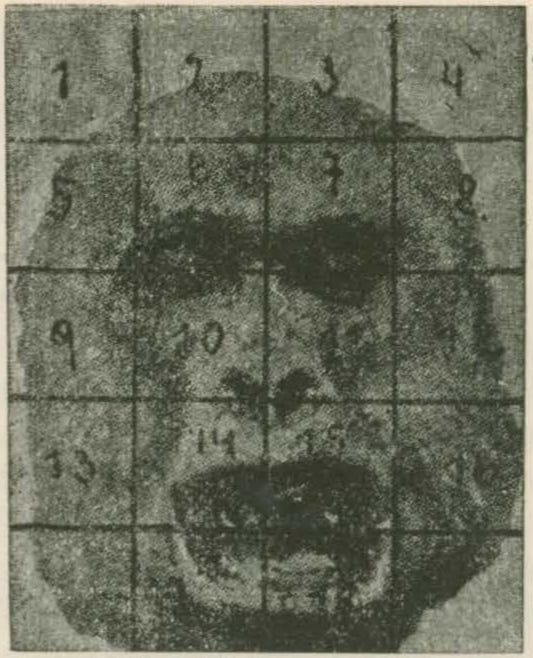
We now turn to the detailed examination and testing of the individual morphological principles. We first consider the face of a gorilla (Fig. 4). The facial line deviates only slightly from the circular form, a sign that the entire skull is spherical. The eye sockets are perfectly round. The same ape-like form is shown by the large and wide nostrils, the gaping mouth, and the jaws. The typical difference between the human and the ape eye is that the ape eye is circular. If one examines the individual facial and eye forms among the anthropoids more closely, one will always encounter circles, circle segments, spheres, and spherical caps.
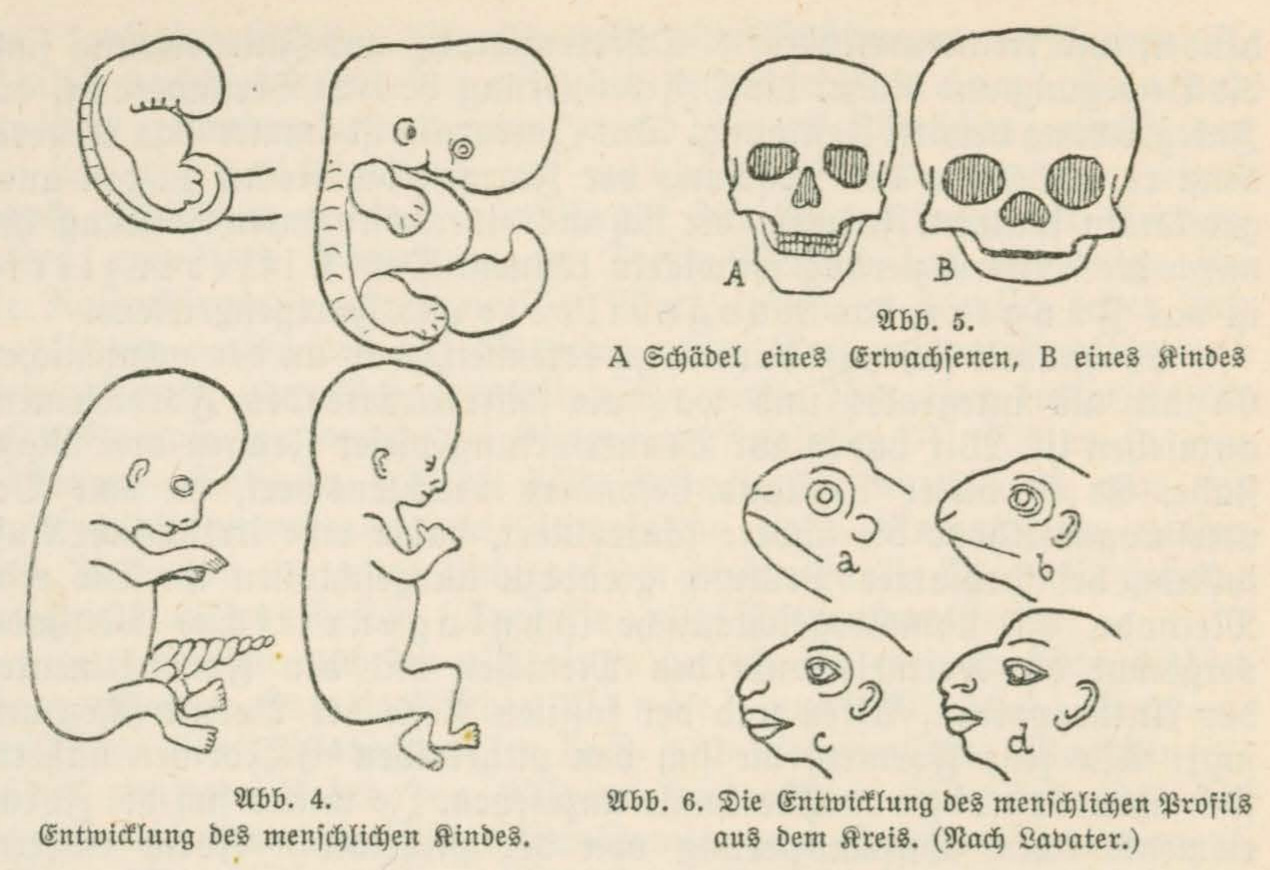
Let us examine the embryo (Fig. 5) of a child by this method. Again we see that the sphere and circle form predominate everywhere. If one compares the individual stages of development of the embryo, one notices quite clearly how nature, like a sculptor, gradually models the differentiated forms of the child out of the round, spherical, and integral forms. This modeling begins first on a large scale and proceeds from the larger sections to ever smaller details. Nevertheless, the skull of the newborn (see Fig. 5) is, in comparison with the skull of the adult, an integral structure. The skull is spherical, the facial outline is circular, as are the eyes, nasal cavities, and jaw.
Without knowing anything about ontogenesis and embryology, Lavater (Fig. 6) in his “Physiognomy” represented the development of the human profile out of the circular form on a purely geometrical basis in a very interesting plate. Of the numerous transitional forms I reproduce only four in Figure 6. One can see clearly how the round profile line becomes progressively more articulated, how the eyebrow arches and eye openings become more elongated, how the chin assumes more angular forms, and how the ears pass from the circular form to the oblong form.

The examination of the individual human groups according to the various morphological methods of investigation has therefore yielded the following result: There are races with integral and differentiated forms; there are pithecoid and less pithecoid forms; there are embryonic-infantile and fully developed forms; there are rounded and elongated forms. Accordingly, we can distinguish: integral, pithecoid, infantile, and round-built races on the one hand, and differentiated, non-pithecoid, non-infantile, and elongated-built races on the other. We simply call the integral races the “lower” races, and the differentiated races the “higher” races. This distinction may have something offensive for members of the lower races. In the individual case it should also not be said that a person of a “low” race must always be a “low” person in the moral sense as well. Nevertheless, it is undeniable that the lower racial characteristics are always closely linked with a less developed (I do not say “lower”) psyche, and Woltmann is right when he says: “Prejudice may well rebel against the idea that intellectual power and intellectual freedom should be determined by bone structure, skin color, and brain mass. And yet it is a law of organic creation that the psychic capacity of living beings is limited by the degree of their physical differentiation.”
In morphological respect, the richness or poverty of pigment in the skin, hair, and eyes must also be regarded as an important racial distinguishing characteristic. For the pigments are connected with the skin, hair, and eye color, which stands in the closest connection with the other morphological characteristics. We distinguish races with light skin, eye, and hair color: the leukodermic race; then races with brownish pigmentation: the xanthodermic race; and a black race: the melanodermic race.
The Anthropometric Differentiation of Races
According to Lepsius, the Egyptians had already occupied themselves with measurements of the human body (anthropometry) and had established an anthropometric canon according to which they divided the upright human figure (not including the hairstyle) into 19 horizontal sections. In later times, Pointlet of Sicyon (5th century B.C.) and Vitruvius (1st century A.D.), in the Renaissance Alberti, Dürer, and Jean Cousin, and in more recent times Gerdy (1830), Quetelet (1870), and Fritsch established anthropometric canons. While the older canons were built up more on aesthetic principles and usually extended to the whole body, the modern canons have perhaps in too one-sided a manner concerned themselves with the numerical proportional relationships of individual organs and body parts, especially of the skull, the face, and the nose.
The modern anthropologists have therefore often done harm to racial science with their results, in that they made race diagnoses based on only one or only a few characteristics, and moreover laid the main emphasis in a one-sided way on the proportions expressed in numbers, without taking morphology into account. Since, according to our definition, race is a complex of characteristics, it is understandable that race diagnoses found solely on the basis of the anthropometric method are frequently defective, if not outright false. Particularly disastrous in this respect was skull measurement (craniometry), under whose influence the anthropologists stood for almost more than a century.
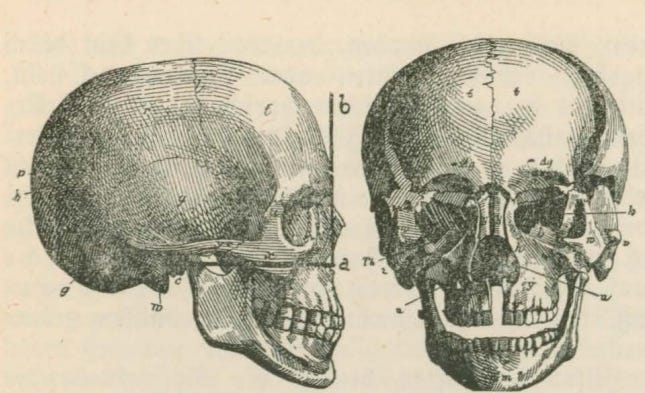
The oldest skull measurement is the facial angle. The facial angle (compare Fig. 1) is the angle formed by the following two lines: one line runs from the foremost point of the upper jaw to the most projecting point of the forehead; the other line runs from the foremost point of the upper jaw to the most projecting point of the occiput (or better, to the ear hole). The facial angle is also called the Camper facial angle, since its introduction goes back to the Leyden professor Petrus Camper (1722–1789).
In the most recent times, deviating from Camper’s facial angle, a “lower facial angle” (see Fig. 1) has been introduced, whose sides are the lines a-z and a-b. a-z is the line imagined drawn from the most projecting point of the upper jaw (the alveolar point) to the lower end of the nasal opening (the subnasal point).
According to the size of the facial angle, human types are classified into: orthognathous (with steep profile) and prognathous (with projecting lower half of the face). For comparison, we give some facial angle measurements: the highest-standing anthropoid apes have facial angles up to 60°, Negroes have facial angles of 70°, the heroic race has facial angles of 80°–90°. Some Greek sculptures even show facial angles of 100°. Faces with an angle over 80° are usually designated as orthognathous, and faces with an angle of 80°–65° as prognathous (C. Gegenbauer: Textbook of Human Anatomy, Leipzig, 1895). In general, anthropologists designate the orthognathous types as the higher types, since in them the masticatory apparatus serving for food intake is less developed than the forehead, which is the seat of the thinking organ and of intellectuality.
Of the greatest importance for the anthropology of the past century was the measurement of the ratio of skull breadth to skull length. The skull index is found by measuring the greatest length and the greatest breadth of a skull, multiplying the skull breadth by 100 and dividing by the length. If l is the skull length and b the breadth, the formula for the skull index i is: i = (b × 100) : l
(This formula also applies to the calculation of all the “breadth indices” given in the following.)
O. Ammon and C. Röse establish the following scheme, to which I also adhere:
Long heads (dolichocephals) with index under 80.0.
Medium heads (mesocephals) with index 80.0–84.9.
Short heads (brachycephals) with index over 85.0.
Virchow introduced the following skull height indices for determining the ratio between skull length and skull height: chamaecephals (low skulls) under 70, orthocephals (normal skulls) 70–75, hypsicephals (high skulls) over 75.
In a similar way, Kollmann introduced for the determination of the ratio of facial height to breadth the terms leptoprosopes (long-faced) up to 90 and chamaeprosopes (broad-faced) over 90.
For the determination of the facial length index the following measurements are taken: as facial height (accepted unanimously by all anthropologists) the distance from the naso-frontal suture to the lower border of the lower jaw. As facial breadth, the greatest distance between the two zygomatic arches is usually measured (on living subjects). (Virchow, on the other hand, measures [on skeletal skulls] the distance between the two upper jaw-zygomatic sutures; Hölder measures the distance between the two inner angles of the cheekbones.)
While in the head index high numbers express strong brachycephaly, high facial indices conversely indicate a very long facial form (formula for the facial index i = 100 × height / breadth).
C. Röse establishes the following scheme with regard to facial forms:
Long faces (leptoprosopes) with facial index over 90.0.
Medium faces (mesoprosopes) with facial index 85.0–89.9.
Broad faces (chamaeprosopes) with facial index under 85.0.
For race diagnosis the form of the eye sockets is also of great importance, to which hitherto far too little attention has been paid, although Quatrefages had already determined orbital indices from the height and breadth of the eye sockets. Quatrefages established the following scheme on the basis of the orbital indices: chamaeconchae (broad-orbited) with index up to 80; mesoconchae (medium-orbited) with index 80–85; hypsiconchae (high-orbited) with index over 85.
In a similar manner Broca and Topinard determined the nasal proportions by comparing nasal length with nasal breadth and established nasal indices and their own groups:
With index up to 47: leptorhine (long-nosed);
with index 47–52: mesorhine (medium-nosed);
with index over 52: platyrrhine (broad-nosed).
For the measurement of the hard palate the following indices and designations were proposed:
leptostaphyline (narrow-palated) with indices up to 80,
mesostaphyline with indices 80–85,
brachystaphyline (broad-palated) with indices over 85.
Scans
