
Ostara Nr. 27
A translation
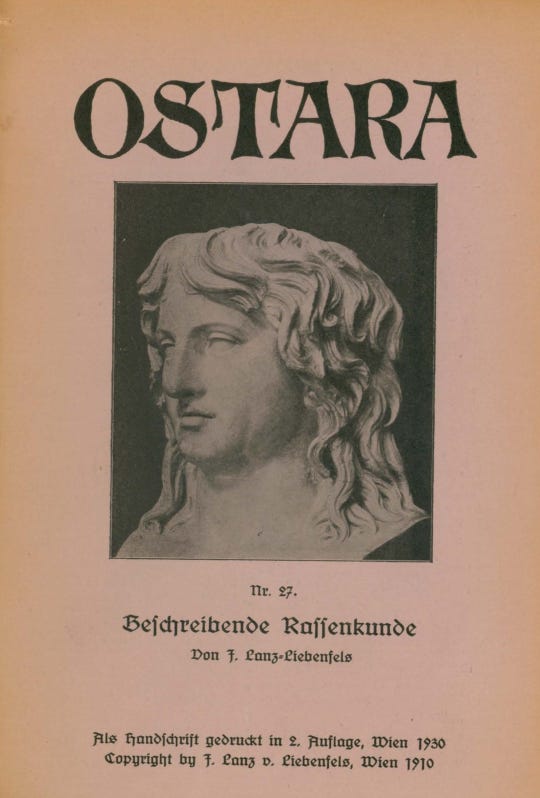
OSTARA
No. 27
Descriptive Racial Studies
from J. Lanz-Liebenfels
Printed as a manuscript in the 2nd edition, Vienna 1930
Copyright by J. Lanz v. Liebenfels, Vienna 1910
Description of the Races and Outline of the History of Racial Studies
Already Kant says, somewhat ponderously, in Engels Philosophie für die Welt, II, p. 133: “I believe that it is only necessary to assume four races of the human species in order to derive from them all the differences that are recognizable at first glance and that perpetuate themselves. They are: 1. the race of the Whites; 2. the Negro race; 3. the Hunnic (Mongolian or Kalmuck) race; 4. the Hindu (probably to be equated with the Mediterranean race) or Hindustani race.”
Linnaeus divided humans into three species: homo sapiens, homo ferus, and monstruosus. A different, more geographical division was attempted by Blumenbach (On the Natural Variety of the Human Race, 1775). He assumed: 1. the Caucasian race (white race), which is at the same time the original race; 2. the Mongolian race (yellow race), to which he assigned all Asian Mongols as well as the Finns and Magyars; 3. the Malayan race (Malays and Polynesians); 4. the American race (red race); 5. the Ethiopian or Negro race (black race). Cuvier reduced Blumenbach’s five races to three races by regarding the Malays and Americans as hybrids of the three main races.
E. Häckel, following Geoffroy Saint-Hilaire and Huxley, proposes the following classification: 1. Woolly-haired (ulotrichous) races: a) tufted-haired; b) fleece-haired. 2. Straight-haired (lissotrichous) races: a) stiff-haired; b) wavy-haired. This system was further developed by Friedrich Müller (Allgemeine Ethnographie, 1879), who established the following scheme:
I. Woolly-haired races: a) tufted-haired: 1. Hottentots and Bushmen, 2. Papuans; b) fleece-haired: 3. African Negroes, 4. Kaffirs (Bantus).
II. Straight-haired races: a) stiff-haired: 5. Australians, 6. Hyperboreans, 7. Americans, 8. Malays, 9. Mongols; b) wavy-haired: 10. Nuba-Fulahs, 11. Dravidians, 12. Mediterraneans.
Following Friedrich Müller, D. Peschel (Völkerkunde, Leipzig, 1885) assumes seven races: 1. Australians, 2. Papuans, 3. Mongols, 4. Dravidians, 5. Hottentots and Bushmen, 6. Negroes, 7. Mediterraneans. Peschel incorrectly and superficially also includes the blond, light-eyed Nordic race among the Mediterraneans. (The racial classifications listed above have no scientific but only historical value; they are testimonies of human error and stem almost entirely from Freemasons, who started from the assumption that there were no racial differences. These classifications, especially in the 19th century, contributed greatly to confusing racial science and preventing it from emerging as a proper science. A chief enemy of racial science and its development was the overbearing and narrow-minded reactionary “Liberal” Virchow. As long as he lived, he suppressed the development of scientific racial studies through terror! In his own special field of medicine, he displayed the same terroristic activity that prevented any progress, as objectively and convincingly shown by Medical Councillor Dr. Franz Bachmann in his excellent book Der Abbruch der Schulmedizin.)
The Swedish anthropologist Retzius took the facial angle and the cranial index as the basis for classification and distinguished:
a) Orthognathic dolichocephals (Germans, Celts, Hindus, Jews);
b) Prognathic dolichocephals (Tungus, Negroes, Australians);
c) Orthognathic brachycephals (Lapps, Finns, Turks, Slavs);
d) Prognathic brachycephals (Mongols and Malays).
A very significant and already more scientific and objective racial classification comes from Gustav Klemm (Gustav Klemm, Die Verbreitung der aktiven Menschenrassen, 1845), who distinguishes two human races: an “active race” and a “passive race.” The active race includes all peoples who appeared as state-founding, culture-creating, and culture-preserving; the passive race includes those peoples who only achieved primitive forms of state and cultural life. (Klemm’s racial system was hushed up because it did not fit into the liberal system of the 19th century. Only Woltmann later drew attention to this theory again.)
Woltmann (Politische Anthropologie, Leipzig, 1903) assumes three main races: Negro, Mongol, and Caucasian, of which the Mongols appear to be much less related to the Caucasians in terms of tribal history than the Negroes, from whom the Mediterraneans and Northern Europeans are said to have gradually emerged. (Woltmann had to pay for his self-sacrificing efforts to establish modern racial science on a scientific basis and to prove the superiority of the blond heroic race with his death. His successes became too alarming for the Freemasons and humanitarians!)
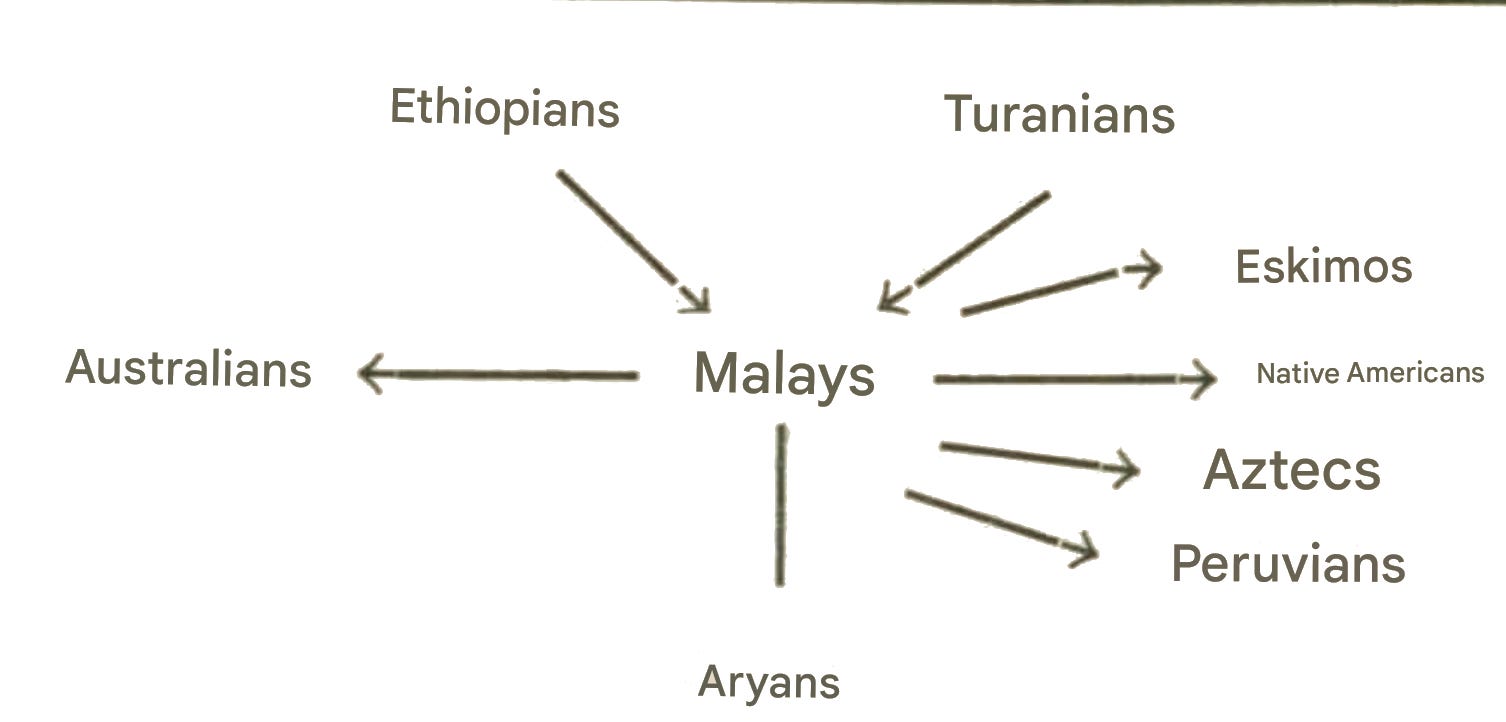
A very interesting view on the races and their origin is held by W. Hentschel (Varuna, Das Gesetz des aufsteigenden und sinkenden Lebens in der Geschichte, 1907, Theodor Fritsch, Leipzig). According to him, one must assume two primary races: the black race (Ethiopians) and the light race (Turanian). The Aryans are said to have arisen from the crossing of these primary races. He gives the following scheme for the developmental process:
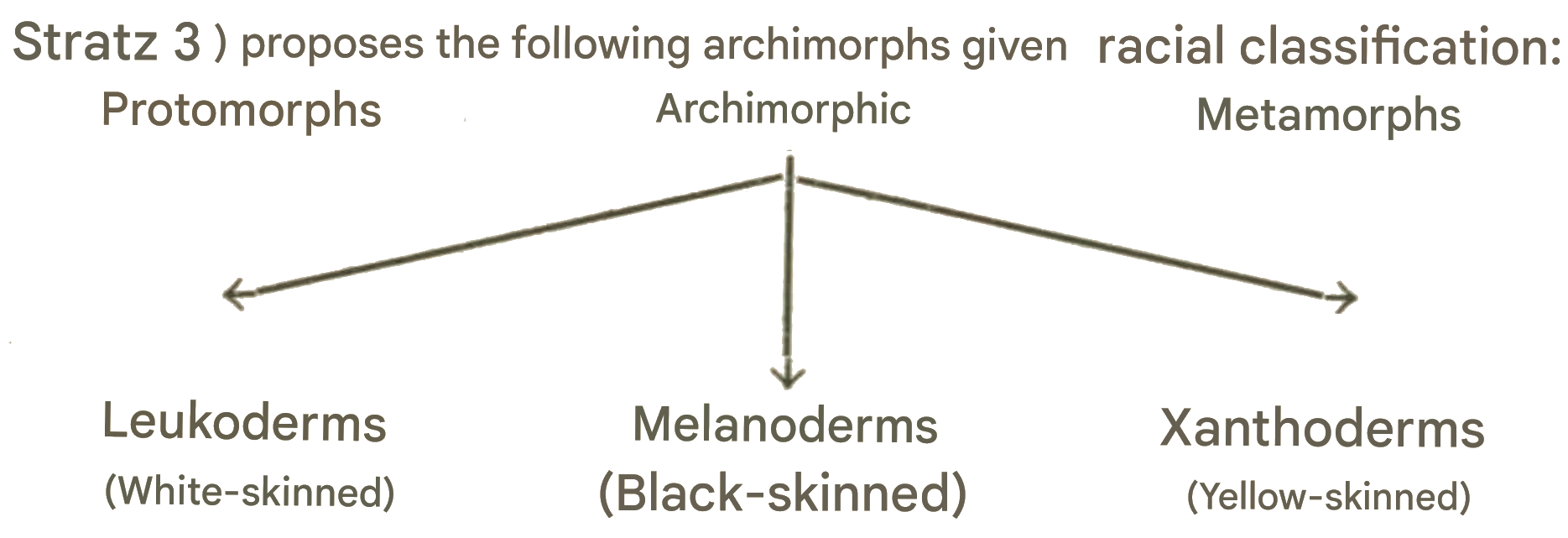
Under protomorphic races Strah understands those races that have remained behind in their development due to isolation and therefore still carry lower racial characteristics. By archimorphic races he means those races that have differentiated and developed according to certain racial characteristics, so that their overall appearance has acquired a certain stability. By metamorphic he understands what we would call hybrids, specifically hybrids of recent origin.
He classifies the following into the protomorphic races:
a) as older protomorphs: the Australians, Papuans, and Khoikhoi;
b) as later protomorphs (descending from the common stem of the white and yellow main races): the native inhabitants of America, the Oceanians such as the Kanaks, Maori, Dayaks, and Tongans;
c) as young protomorphs: the Affa (as a melanodermic mixture), the Eskimos (as a xanthodermic mixture), and the Ainu and Vedda (as a leukodermic mixture).
However valuable and entirely accurate Strah’s researches may be in one respect, we must nevertheless reproach him on the other side for the fact that his book refuses to acknowledge the difference between the Nordic and Mediterranean races — a difference that has now been established in a completely unobjectionable and exact manner by the chemical racial test. On page 368 of his Naturgeschichte des Menschen he says: “From the ethnographic side an attempt has been made to strictly separate a group of primitive Germans, who are supposed to have become isolated in the North and Baltic Sea regions, from the rest of the race. But since the characteristics of this race — blond hair, blue eyes, tall stature — the only somatic features cited in support of this theory, neither have such great significance (This is simply not correct) nor belong so exclusively to a single human group (This is illogical! For we precisely group only blond and light-eyed types into one human group! Then they cannot occur in another race. I quote this passage precisely to show with what primitive, indeed childish means the racial question is being confused!), this view is, from the anthropological standpoint, nothing more than an unproven hypothesis.” We shall show in the special racial studies that the difference between the heroic and Mediterranean races is not only biochemically founded, but also morphologically and anthropometrically.
Before I undertake a classification and nomenclature of the human races according to the principles I have established, I wish to subject the classifications and names mentioned above to a brief critique. For the defective and often downright misleading nomenclature has caused much harm among both laymen and scholars and has severely damaged the reputation of racial science as a discipline.
With regard to classifications, we agree with Herbert Spencer, who says that more or less all classifications are only subjective concepts to which no boundaries in nature correspond, but which humans employ in order to understand one another. Without terminology, science cannot be communicated to a larger circle of people.
Having made it clear that race is a complex of characteristics, and that these characteristics stand in an inner connection of morphological correlation, all racial classifications obtained by a one-sided method and the examination of a single characteristic are therefore incorrect and misleading. Consequently, all racial classifications that take into account, for example, only the facial angle, or only the skull, or facial or orbital indices, are false. Equally inaccurate are classifications that merely consider skin color (as Stratz does) or hair (as Häckel does). Names of geographical, ethnological, or even linguistic origin are likewise to be rejected. For we have explained above that place of birth, national affiliation, and language decide nothing about racial affiliation. For example, the designation “Nordic” race, as well as “Germanic” or “Aryan” race, is not correctly chosen.
Jean Finot (Das Rassenvorurteil, p. 305) rightly says that the concept of an Aryan race is absolutely to be rejected. “For at bottom it is only a matter of an Aryan language family, which by no means presupposes an Aryan people.” Max Müller expresses it more drastically when he says: “The ethnologist who speaks of an Aryan race, of Aryan blood, Aryan eyes or hair, commits the same sort of nonsense as the linguist who wanted to speak of a dolichocephalic dictionary or a brachycephalic grammar.” (The history of modern racial science is a martyrology! The young people who today enjoy the fruits of our quarter-century-long struggles have no idea of the difficulties it cost to establish racial science as a recognized discipline. But we have succeeded. The concept of race as an anthropological term, as I first conceived and consistently applied it, has become the foundation of modern scientific racial science and common property [cf. Kern: Rassenschutz, and van Bergh: Affenmensch oder Menschenaffe, Verlag Reichstein, Pforzheim]).
Taking into account the investigative method I have adopted, I establish the following racial scheme:
Homo aesus or heroicus.
Mediterranean man.
Homo niger.
Homo mongolicus.
Homo promiscuus:
a) primitivus,
b) recens
1. Homo aesus or heroicus (the heroic [“Aesir-like”] man). (So named after the anthropology of the Edda, which is probably closest to us. At the same time, aesus (the Ase) and Heros express the cultural significance of this noblest race and its divine descent.) Biochemically the furthest removed from the orangutan, sensitive to electrical influences, and therefore possessing a highly developed nervous system. Morphologically the furthest removed from the anthropoids and the infantile (childlike) state, its outlines show a harmonious combination of straight and curved lines. It has wavy, blond hair, gray or blue eyes, and a light, rosy complexion. Anthropometrically: orthognathic, dolichocephalic, leptoprosopic, mesoconch, leptorrhine, with proportionate body and limbs. Body height over 170 cm. “The (heroic) race possesses on average the largest and strongest physique and combines this with a proportion of the limbs that, when measured by the golden section, simultaneously realizes a purposeful division of masses and an aesthetic ideal” (Woltmann, Die Germanen in Frankreich, Jena 1907).
Along with these physical characteristics go all those psychic traits that are commonly praised as the special character qualities of the noble, good, and wise human being. The heroic race is at the same time the active and productive race. Its main area of distribution is northern (Germanic) Europe and North America. Northern Europe is also, as the pioneering researches of Penta have shown (Origines Ariacae 1883; Die Herkunft der Arier 1886; Die ethnologisch-ethnographische Bedeutung der megalithischen Grabbauten, Mitteilungen der Wiener anthropologischen Gesellschaft XXX), the original homeland of this race.
Unconsciously, Lavater (op. cit. III, p. 22) had already been struck by the special peculiarity of the heroic race. He does not yet speak of races, but only of national physiognomies, and expresses himself as follows: “One perhaps learns to recognize the national character of a face more easily if one does not first see the entire nations, does not go to them; if the nation first appears to us only in individual persons. At least that is how it seems to me from my experience so far. Individual faces open our eyes to the characteristic features of entire nations more readily than entire nations do.” After observing all the foreigners he encountered, he states that he has discovered nothing more than the following very small amount. Having admitted that most European nations do not possess a striking physiognomy (understandably, since only races as anthropological concepts, not nations as political concepts, can have definite physiognomies), he comes to speak of the English, who were at that time the relatively purest European nation, and says: “The English have the shortest and most arched foreheads, that is, they arch only at the top; below, toward the eyebrows, they are otherwise taut or straight-lined. They rarely have pointed, but often round, blunt, strong noses. Except for Quakers and Moravians, who generally have lipless mouths all over the world, the English have large, well-shaped, beautiful lips and a round, full chin; but they are distinguished above all by their eyebrows and eyes, which are wide open, free, and striking. Their faces are in general drawn in a grand manner. They lack everywhere the infinitely small, many secondary features, folds, and furrows that particularly distinguish German faces. Their complexion is whiter than that of the Germans. All English women whom I have seen in nature and in pictures seem to be formed of marrow and nerves, are elongated, slender, delicate, and infinitely far removed from all roughness, hardness, and abruptness.”
Lapouge gives the following description of the man of heroic race: “He understands better how to acquire wealth than how to keep it; he accumulates it easily and loses it just as easily. By nature adventurous, he risks everything, and his boldness secures him incomparable successes. He fights for the sake of fighting, but always without the ulterior motive of advantage. He thinks logically and does not let himself be put off with words. Progress is his strongest need. In religion he is a Protestant (?) and demands from the state only respect for his activity (not tutelage and provision!). He is found in Great Britain and also forms the predominant (maritime) element in Belgium, Holland, the parts of Germany bordering the North and Baltic Seas, and in Scandinavia. In France and especially in Germany he counts as a subordinate but still important component among the inhabitants of the plains; at altitudes over 100 meters he is rare.”
As Röse quite correctly says, there exists an undeniable correlation between long-headedness and moral feeling. There are nowhere in the world more sincere, honest, and noble people than in the purely racial regions of England, Lower Saxony, and Sweden. The shorter-headed the inhabitants of a country are, the more property crimes occur. It is a fact established by criminal anthropology that the honesty and sincerity of people decreases with distance from the Nordic original homeland of the heroic race. (It is significant, but only proves my theses already put forward in 1910, that Bolshevism was able to develop precisely in strongly mongoloid Russia and that the Red Terror Guard consisted entirely of pure Mongols, Koreans, Chinese, Tatars, etc.!)
According to Lapouge, the number of people of heroic race amounts to only 30 million in Europe and 20 million in America. From this one may recognize what an enormous burden of work rests on a relatively small people — the smallest human race — which must be not only the founder but also the preserver of culture.
2. Homo mediterraneus (the Mediterranean man). He is, as it were, the unfinished and inharmonious heroic man. He is the man of extremes physiologically, morphologically, and anthropometrically. Biochemically he stands one step closer to the orangutan than the Heroic type. Physiologically the Mediterraneans are the most nervous people and therefore form the main contingent of the mentally ill. Morphologically they are distinguished by an inharmonious, pointed combination of straight and curved lines. Characteristic of them is the typical convex facial profile (hook nose, Jewish nose), wavy to curly, dark, very strong hair, very strong beard and body hair, dark eyes, brownish-white skin color. Anthropometrically: prognathic, dolichocephalic, leptoprosopic, hypsiconch (therefore protruding eyeballs), leptorrhine, with overlong (“ape-like”) arms and short legs.
The main area of distribution and origin of this race is the Mediterranean region. Hence the name “Mediterranean” introduced by Broca and Huxley. Many (but not all) Western Jews, a large part of the Spanish, French, Italian, Greek, Romanian, Turkish, Serbian, Bulgarian, and Arab peoples belong to the Mediterranean race. In their psychic qualities they stand closest to the heroic race. One can only call them overactive, that is, they are too mobile and fantastical. As inharmonious as their exterior is their psyche. When they attain hegemony, they always usher in epochs of over-culture and decadence. They are the “progressives” and “world politicians.” Their merit to culture consists in their fermentative and decomposing power.
3. Homo niger (the Negro). Physiologically less sensitive than the first two races, he stands biochemically closer to the anthropoids than the heroic and Mediterranean man. In morphological respects he shows the following characteristics: phylogenetically (in terms of tribal history) he has very many pithecoid (ape-like) features; in the line structure the round and spherical predominates; the facial profile is strongly concave; curly or woolly dark hair; dark eyes; black skin color. Anthropometrically: very strong prognathism, dolichocephalic, mesoprosopic, chamaeconch, platyrrhine (flat-nosed). Overlength of arms and legs in comparison to the trunk.
The Negro has his homeland and main area of distribution in Africa. He has played virtually no role in cultural history — a proof of how modestly his intellectual powers are to be estimated. At most he has achieved something as a slave, and even then not much, for he knows no diligence. Insofar as a “Negro culture” can be demonstrated, it is Atlantic inheritance.
4. Homo mongolicus (the Mongol). Biochemically the Mongol stands two steps closer to the orangutan than the Mediterranean. Physiologically he is the least sensitive. In morphological respects he shows fewer pithecoid than infantile characteristics. In the line structure the round and spherical predominates, along with the tendency toward excessive breadth development. The facial profile is concave, the hair dark and straight, beard and body hair very weak, the eyes dark, the skin color yellow. Anthropometrically he is prognathic, but not as strongly as the Negro; he is a pronounced brachycephal, chamaeprosopic, mesorrhine to platyrrhine, hypsiconch. The extremities are short in comparison to the trunk.
Lavater describes the Mongolian race quite aptly as follows: “All Tataric peoples have a face that is very broad at the top and already wrinkled in youth, but narrow below, a short and thick nose, small and deeply set eyes, very prominent cheeks, a long and protruding chin, jawbones that are depressed above, separated teeth, thick eyelids, an olive-like complexion and black hair. They are of medium body height, but very strong in strength; they have a thin beard, which, as with the Chinese, consists of a few thin tufts of hair; their thighs are thick and their legs short.”
The most striking character trait of the Mongols is their gift of imitation and their diligence. They are the typical reproductive human beings with mercurial intelligence. The homeland and main area of distribution of the Mongolian race is Asia. They are willing and capable slaves. In world history they have played a role only through their enormous numbers and their demonic lust for destruction (Huns, Avars, Turks, Mongols, Bolsheviks — fundamentally all one race!).
5. Homo promiscuus (the hybrid). It is pointless to set up and name any further races besides the four main races mentioned above. For all types that occur outside the four basic types can quite well be placed in one group of racial hybrids. At most one can make the distinction of dividing the hybrids into primitive and recent hybrids. The primitive mixed races are mixed races that arose through pre- or early-historical crossing and have already developed into distinct types. Recent hybrids are those that are still being produced by crossing in the present day.
The hybrids are the most numerous human races and they form the transitions to the individual races by combining the characteristics of the four main races in countless combinatory forms. Depending on which race’s characteristics predominate, they approach one of the four main races, and one can then speak of Heroics, Mediterraneanoids, Negroids, and Mongoloids. The surest method for determining which main race a hybrid is closest to will always be the biochemical one. It is confirmed and supported by the morphological method.
The primitive hybrids have their area of distribution in the “marginal zones,” which are characteristically the furthest removed from the European original homeland of the heroic race (South Sea islands, Australia, South America, etc.). The race of primitive hybrids, which roughly corresponds to Strah’s race of protomorphs, is a quite colorful mixed society. Here we see all possible facial types represented — a sure sign that this race is not a pure race by origin, but owes its existence to panmixia. I therefore place it, in contrast to the main races, on the same level as the recent hybrids.
Particularly noteworthy is the phenomenon of convergence that appears here, as so often in nature. The facial forms produced by modern general racial mixing resemble to the point of confusion the types of the primitive hybrids. Especially in the European industrial districts sinking into general mixing — such as the Rhenish coal districts, northern Bohemia, the Kingdom of Saxony, and all modern large cities — we encounter types that have their striking doubles in Papuan, Ainu, Vedda, and Khoikhoi types. It is also quite understandable that the same causes must produce the same effects. On the other hand, this apparently so incomprehensible parallel phenomenon — that our modern “cultural and big-city people” resemble the lowest human races in such a surprising way — points to the same cause of origin, namely panmixia (universal mixing) and the lack of strict pure breeding.
That is why among primitives we encounter on the one hand surprisingly highly developed forms that even approach the heroic racial type, and on the other hand types that come closer to the Mongolian or Negro race. Anthropologists call this phenomenon “great variability range.” But great variability range is always the consequence of intensive hybridisation. From the plant kingdom I mention only the multiplicity of forms of rose varieties known to every flower breeder. An example from the animal kingdom is the many varieties of monkeys and dogs, all of which are demonstrably the result of intensive panmixia and occasional pure breeding in a particular direction.
It is therefore understandable that Strah (like all other anthropologists) is usually in the greatest embarrassment as to whether he should assign a tribe to the protomorphs or the metamorphs. Thus Strah says in Naturgeschichte des Menschen, p. 329, of the Kanaks and Tongans that they are protomorphic, yet “metamorphism from the coast is possible.” On page 336 of the same book he says quite clearly: “In Oceania the protomorphic race is increasingly absorbed by the seafaring Malayan hybrid tribes advancing from the coasts.”
One very often hears talk of the “Alpine” or “Turanian” race. I believe it is better to subsume this concept under the name I have proposed, “recent hybrids” (homo promiscuus recens), since the “Alpine” type is not found only in the Alps but everywhere where mixing between homo heroicus and homo mongolicus has taken place. (I similarly regard the Dinaric type as a mixed race.)
Lapouge describes this recent Alpine hybrid type as follows: The average body height is 1.60 to 1.65 m, the cranial index 85 to 86. These hybrids are stocky, short-legged, brachycephalic, and have brown or dark skin, hair, and eye color. They are moderate, industrious, thrifty, and clever. Their tendency is to earn and enjoy money; everything higher and spiritual seems to them superfluous and impractical. Their endeavor is to level everything down and pull it downward — a drive that springs from their psyche, which arose from mixing.” In their political attitude they are democrats or socialists, unless they prefer to be philistines. For the German beer drinker and philistine, the German schoolmaster as a petty, envious, and grumbling pedant, the German bureaucrat whose only concern is to collect his salary on the first of every month, and the police sergeant who crawls to those above and is rude and snooping toward those below — these are all types of that race of homo promiscuus recens.
Origin of the Races
At this point I can give only the most fleeting outline of the history of the origin of the individual races, for even a halfway exhaustive presentation would exceed the scope of this booklet many times over.
In the origin of races we must recognize exactly the same two natural forces that play the most important role in morphology: namely, differentiation and integration.
Differentiation is effected by differences of climate, geographical position, and soil composition (with which the mode of nutrition is connected) in the original homeland of a race. Of the most incisive differentiating importance for a race can be long-lasting isolation, as was evidently the case with the heroic race during the Ice Age, which was cut off from the south by a wall of ice. Natural and sexual selection also act in a differentiating manner. In this respect the heroic race for the longest time stood under the influence of a sharp natural selection, as was brought about by the harshness of the Nordic climate.
Besides the natural factors of selection, however, the intellectual factor of selection in the origin of races must not be overlooked. The heroic race is, as I have set forth in my “Theozoology” (“Ostara” Nos. 5–9, 15–19), by no means the result of the development of exclusively impersonal forces. In earlier periods of earth development, humanity stood under the influence of “gods,” “angels” of the myths — beings that have since become extinct and were equipped with quite peculiar (electrical) forces and endowed with intellect — which perhaps influenced the origin of the individual human races through pure breeding just as strongly as the differentiating forces of nature.
Hugo de Vries has assumed a new species- and race-forming force, mutation, which consists in an individual spontaneously developing in a certain direction and thereby becoming the progenitor of a new race or species in which the new characteristics are constantly inherited. But by this theory, which is today accepted by most natural scientists, de Vries has merely given a new name to the hitherto unknown force that changes species, without penetrating into the essence of the matter. For we involuntarily ask how it comes about that a species suddenly loses its hereditary power and spontaneously produces a being unlike itself. From the mutation theory to the theozoic theory established by me there is only a small step, in that it becomes probable that those primeval beings equipped with special forces were able to change species spontaneously. I would here draw attention to the strange phenomenon that from hen’s eggs irradiated with radium rays during incubation, quite monstrously formed chicks developed. The spontaneous “mutations” observed by de Vries in some cases can easily be traced back to the action of various rays.
Opposed to these differentiating forces, the integrating forces made themselves felt: nature through convergence, intellectual beings through crossing.
By convergence v. Luschan understands the phenomenon that different animal and plant species, even if they stand far apart in the system of kinship, develop in the same directions and thus approach a common type. That crossing produces a mixing of the individual racial characteristics and a blurring of racial types needs no elaborate proof.
Following ancient reports and G. Biedenkapp and Sebald, I assume a bipolar development of life on earth. The earth’s poles were the first to cool. Life must therefore have developed first at the poles. The fact that the two regions are no longer sharply distinguished today means nothing, for it is probable that the earth has not always rotated on its present axis, that the north and south poles have changed places, and therefore both regions came into contact with each other at an early date and thus made mixing possible. Moreover, the similarity of the flora and fauna of the northern and southern hemispheres can also easily be explained by convergence.
After in later periods the land masses became concentrated more around the northern pole, the struggle between the two regions was decided in favor of the northern hemisphere. Here the individual species could develop and differentiate more quietly and steadily. I would only point out the predominance of dicotyledonous flora in the north and the less differentiated monocotyledonous flora in the south.
We do not enter more closely into the question whether humanity is of polygenetic or monogenetic origin, for it is quite out of the question that the whole of humanity descends from a single pair of parents. This view, after all, rests only on a demonstrably false interpretation of the Bible, which understands Adam not as an individual but as a species (kind). The origin of the races did not take place under the influence of a single force, but under the influence of all the species-forming forces mentioned above. Crossing, however, was effective to a special degree. The family tree of man can therefore not be represented in simple, parallel lines, but only by crossing lines.
Catastrophes such as the sinking of entire continents, fluctuations of the earth’s axis and of temperature have interrupted developments and caused new lines of development. The present picture of the earth’s surface and of present-day fauna can hardly give us a reliable picture of these catastrophes and their after-effects. Here we are dependent on the reports of ancient anthropology and Ariosophy, which roughly report the following: The primeval primates (roughly Tertiary) divided into the branches of the theozoic or pre-heroic races and the anthropozoic races and the anthropomorphic apes. Among the anthropozoic races there appear above all three special groups: Pagu-men (Niders) as ancestors of the Negroes, Bezah-men (dwarfs) as ancestors of the Mongols, and Adam-men (giants) as ancestors of the Mediterraneans. From the more or less intensive mixing of the pre-heroic races with these groups and of the three groups with one another there then arose, already in the Diluvium, the present five main races in the form in which we have described them above.
From all this it follows that the heroic race alone has taken the relatively steadiest path of development, while the lower races are to be regarded as aberrations and disturbances of this development. This view is held not only by ancient anthropology but, fortunately, is also shared by the most modern anthropologists such as Stratz and Klaatsch (Entstehung und Entwicklung des Menschengeschlechtes, Stuttgart 1902), and above all by A. K. van Bergh (Affenmensch und Menschenaffe, Verlag Reichstein, Pforzheim, 1930). The heroic humans, as the biochemical diagnosis clearly shows, have never passed through an “ape stage”; they have taken their own path — the divine path. To be sure, they too, like the other races, have strayed from this straight path, but they have always returned again to the course appointed to them by God.
The Modulus Net as an Aid to Special Racial Research
In order to place even special racial science, which deals with the investigation of the individual racial characteristics, especially of the skull and face, on a firmer basis, I have looked around for suitable aids that would make possible a more exact description, differentiation, and evaluation according to position, size, and proportion than the anthropometric methods and their index calculations were capable of.
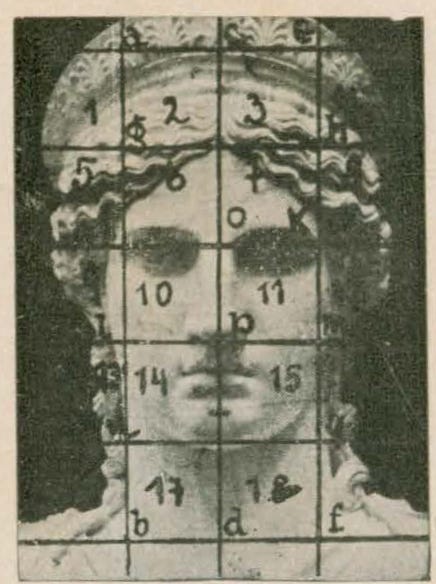
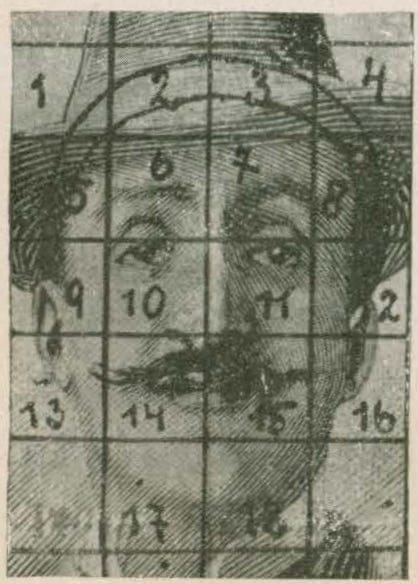
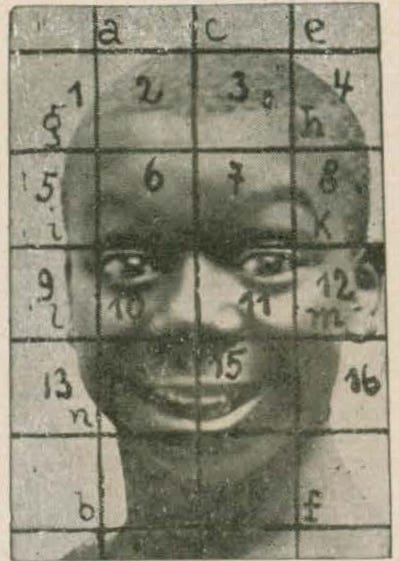
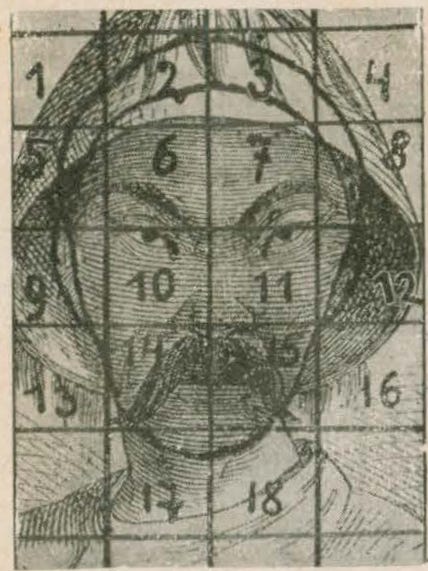
I have found the canon of G. Audran (Les proportions du corps humain, Paris 1683) to be the most practical, have applied it in the present investigations, and have further developed it into my anthropometric modulus net. I have constructed a modulus net for both the en face and the profile position of the head. Since the racial researcher works more conveniently and exactly with photography than with measurements taken directly on the head, I had to choose a system that would make it easy to find the modulus on a photograph. On the other hand, the modulus had to be a measurement that appears on the picture undistorted in both a profile and an en face photograph. In addition, one and the same modulus had to be used for both the en face and profile positions. As the most suitable basic measurement (modulus) I have found the distance from the upper edge of the iris to the attachment of the nasal wings (distance o-p in the en face illustration, Fig. 12). When photographing, the head must be positioned so that in the en face position the nasal axis and in the profile position the line connecting the iris with the corner of the mouth stands vertically.
On an en face picture the upper edges of the iris are connected by the line i-k, and in the middle the vertical midline d-c is drawn perpendicular to it. From the intersection point o the modulus is now marked off on the vertical e-d and on the horizontal i-k as often as is considered necessary, and the verticals a-b and e-f and the horizontals b-f, n-o, l-m, g-h, and a-c are drawn in (cf. Fig. 12).
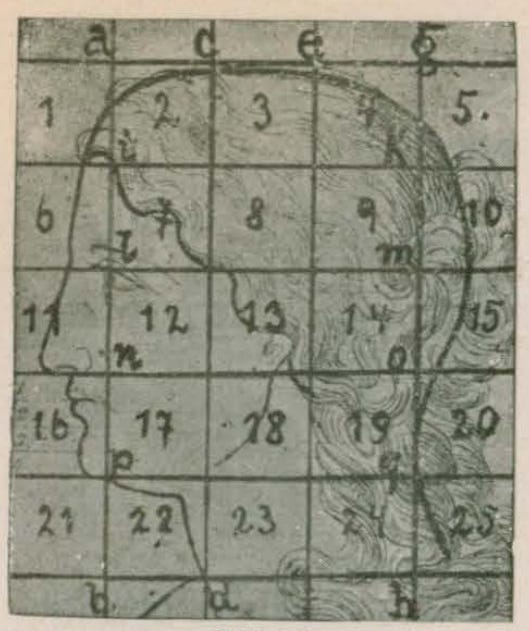
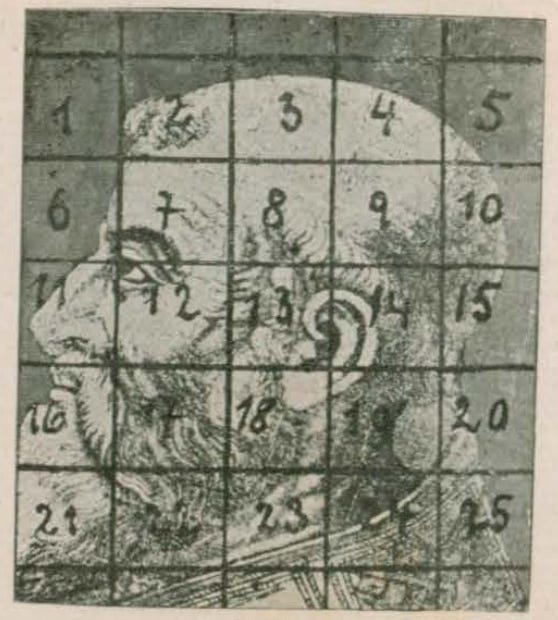
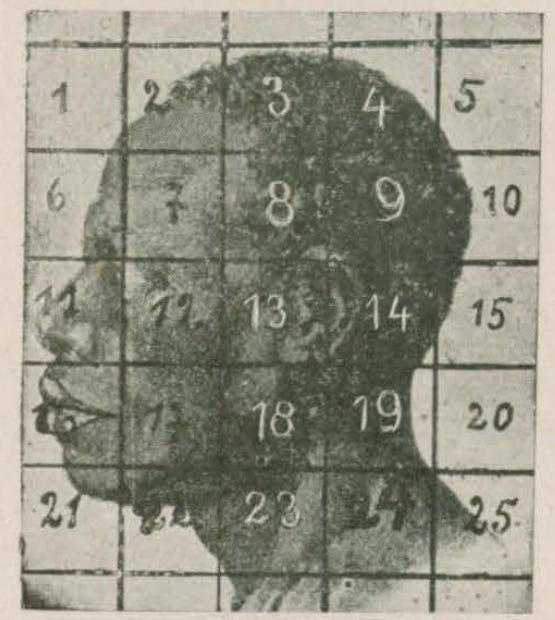
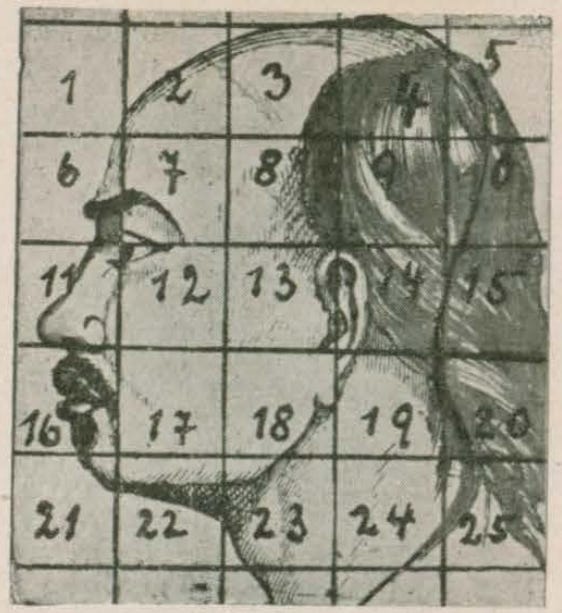
On a profile picture one first connects the upper edge of the iris with the corner of the mouth and extends this line upward to a and downward to b and aligns this line parallel to the right and left edges of the drawing paper. From 1 one marks off on this line the distance to the attachment of the nasal wing and thus obtains the modulus 1-n. The modulus is now marked off on the line a-b and the horizontals a-g, i-k, l-m, n-o, p-q, b-h are erected at a, i, l, n, p, and b. On a-g the modulus is likewise marked off and the verticals c-d, e-f, g-h are drawn. The modulus quadrants produced by this network of lines (which, if necessary, can each be subdivided again into smaller quadrants) I have numbered (cf. Fig. 8).
The Skull
The more we succeed in elucidating the wonders and riddles of electricity, especially its connections with light energy, the more probable it becomes that nerve and brain activity is of electrical origin. I even go so far as to describe the human brain as a receiving and transmitting station for electrical force waves. This assumption allows us to penetrate deeply into the psyche of the individual races and above all explains to us many morphological peculiarities that we can observe in the different racial skulls, racial foreheads, and racial brains. We know from physics that the quantity of electricity depends on the size of the surface, the tension on the form of the surface of the condenser. Larger surfaces can absorb more electricity but also give off more. Angular forms are better suited both for emitting and for drawing in electricity. Unfortunately brain research still offers us little material in this respect; I also wish to reserve a closer treatment of this subject for racial psychology. In general, however, I agree with Röse and assume with him that the heroic race has a more developed cerebrum than the non-heroic races and that the cerebral cortex shows a finer subdivision and folding. This more differentiated formation with its many protruding bulges and receding furrows on the one hand produces a larger surface, and on the other hand, corresponding to electrical condensers, is better suited for the storage and release of electrical (intellectual) forces. The size of the skull and brain is decisive for the quantity of mental energy, the form of the skull and brain for the tension of the mental energy. (Cf. also Burger, Geheimnis der Menschenform.)
Let us first consider the skull forms of the different races in the modulus net of the profile position. In the heroic race the outline of the forehead rises steeply in quadrant 1 and occupies almost the entire quadrants 2 and 3 except for a small triangle, in order to fall again in quadrant 4. In the lower left corner of quadrant 5 the outline bends downward again, cutting off moderate areas from quadrants 10 and 15. The overall form of the skull in profile is therefore a harmonious combination of straight and curved lines (cf. Fig. 8).
It is different with the skull profiles of the Mediterranean and Negro races. The forehead profile no longer projects into quadrant 1 at all. In the Mediterranean and Negro races the highest arch is, similarly to the heroic race, in quadrant 3. But in the Mediterranean race the skull vault is lower than in the heroic race, and in the Negro race one already notices clearly how the development of the skull strives more and more backwards. The outline forms also become rounder to an increased degree. The Mediterranean race holds the middle position. The skull vault still attaches rather markedly to the forehead in quadrant 2, and the skull outline still cuts into quadrant 5. In the Negro profile the skull vault rises very gently from the forehead in quadrant 2 and descends in a uniform rounding, barely touching quadrant 5, through quadrants 10 and 15 to the base of the neck.
If we summarize our observations, it follows that the Mediterranean and Negro skulls are lower than the heroic skull. The Mediterranean skull, however, still shows angular outlines, though already blurred. The occiput projects more strongly backwards than in the heroic skull. In the Negro the skull profile shows a uniform rounding shifted as a whole backwards. Through the loss of skull content both in quadrant 2 and in quadrants 5, 10, and 15, the smaller capacity of the Negro skull is clearly recognizable. In the Mongolian head the skull has its arch in quadrant 4; forehead and skull vault merge into one round, elliptical, or parabolic line. Quadrant 1 is likewise not intersected; the occiput still reaches strongly into quadrants 5 and 10, whereby the capacity of the skull appears larger than in the Negro. In the Mediterranean race the occiput is developed more in length, in the Mongols more in height.
Already the skull forms thus indicate the character peculiarities of the different races. The heroic race has a large and differentiated skull: therefore great and also ordered intelligence. In the Mediterranean race the intelligence is smaller, but corresponding to the angular skull forms it still possesses great tension. The Negro has little intelligence and little tension, the Mongol a great deal of intelligence and the least tension. The skull already indicates by its breadth development that it is better suited for the reception than for the penetration and creation of thoughts.
